

Soul-Murder
A personal essay on abuse, trauma bonding, and Paul Williams' Nothing Happened

Who the fuck beats a 3-year-old kid with a belt?
(This essay might be hard for some people to read. Read it anyway, but maybe in a place and at a time where you can sit well with your emotions).
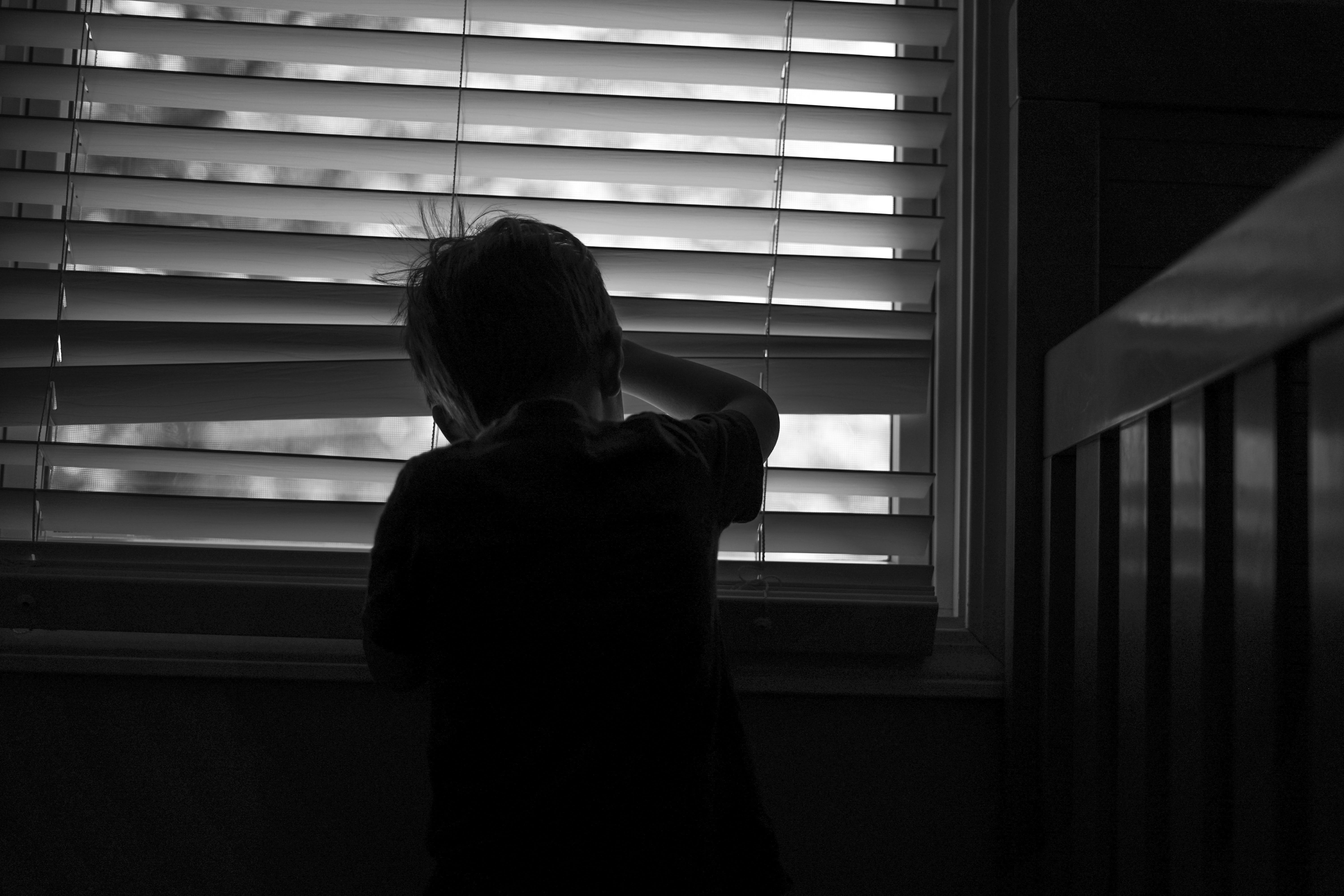
There’s a thing that, even as a writer otherwise unafraid of addressing difficult things, I don’t feel comfortable writing about.
I make occasional references to my childhood, certainly. And among those references, I scatter enough slant glances towards the more painful parts of it that anyone literate enough in my work could probably guess more. But to tell you about what I really want to tell you about, and to tell you in a way that you really understand what I mean, I guess I’ve gotta be more direct about this part.
From the time I was 2 or 3 until about the time I was 10 or 11, my father beat me with a belt, sometimes so bad that I’d go unconscious.
I don’t remember the earliest beatings, but I know they happened when I was toddler. I know this, because I finally confronted my father about it because of a book I was editing. When I confronted my father about it, he told me, in the most twisted kind of logic you could imagine, that he’d actually stopped beating me when I was 3. In fact, he was quite proud to tell me this fact, and didn’t seem to think there was anything weird about beating a toddler with a belt.
Who the fuck beats a 3 year old kid with a belt?
He hadn’t stopped, of this I can assure you. The beatings continued until I was about 10 or 11. Often, they were so bad I’d black out during them, and around the time I was 8 or maybe 9, I started waking up in the middle of the night, screaming. Eventually, those night fits got so frequent and so severe, and also my behavior at school got so erratic, that my parents were forced to take me to a child psychologist.
I didn’t know they’d been forced to take me. Worse, because of my father’s anger about it, I thought they were happening because I had done something very, very wrong.
I remember those sessions pretty well, because I learned to play all kinds of games I’d never played before. She had Milles Bornes, and Sorry, and even Connect Four, games I’d seen advertised on television but never imagined I’d get to play in real life. She’d asked me questions while we played these games, but I was very confused. It didn’t make sense that I got to play all these games even though I was there because I’d done something really bad.
A few sessions later, the beatings stopped and so did the sessions. Nothing was said to me, no apology or explanation. I didn’t even realize they’d stopped, yet. I was always expecting them to happen, but they didn’t come. In the car with my father, a year later, I asked him why they’d taken me to the psychologist and if she’d ever told him what was “wrong” with me.
Angrily, he spat out, “She said I can’t hit you with the belt no more.”
When your childhood is like this, you learn a few tricks to get through. I learned that I could “jump” outside of my body when he was whipping me. I could float a bit next to myself, outside the event, so that the pain didn’t feel so bad. It still hurt like hell, of course, but it was like I was watching it all on television and so I could tell myself it wasn’t real.
When you jump out of your body like that, though, you can’t really jump back in. You get disconnected from your body, and start to fear and even hate it.
But another thing happened, something that seems far stranger still. You’ve probably heard of a “trauma bond.” As with many other psychological terms these days, its specific meaning has drifted significantly on account of adolescent (in age and in mind) social media influencers making “content” from ideas and research they don’t understand. Suddenly, everyone thinks they’re autistic (and it’s a “superpower,”) or everyone they don’t like is a narcissist, or kids are smashing their cheekbones with hammers because they read that repeated stress (from weight lifting, not “bone smashing”) makes those bones grow thicker.
That’s how a “trauma bond” came to mean a deep connection between people who experienced trauma together, which is not at all what it meant. Instead, it’s a lot closer to what was meant originally by Stockholm syndrome. It’s a psychological process, a disorder, where a victim of abuse gets stuck in the abuser’s gravitational pull and seeks approval, safety, and security from the very person who’s threatening it all.
Anyone abused as a kid probably knows immediately what I’m talking about, as does anyone who’s been in a domestic abuse situation. You become fiercely loyal to the person hurting you, and also fiercely subservient. You actually protect them from others finding out how violent they are, and you make up all kinds of excuses for their behavior, and you do all of this because you’re still looking for their love.
I did this all until last year. That’s when I began editing work on Paul Williams’ novel (just released today), called Nothing Happened.
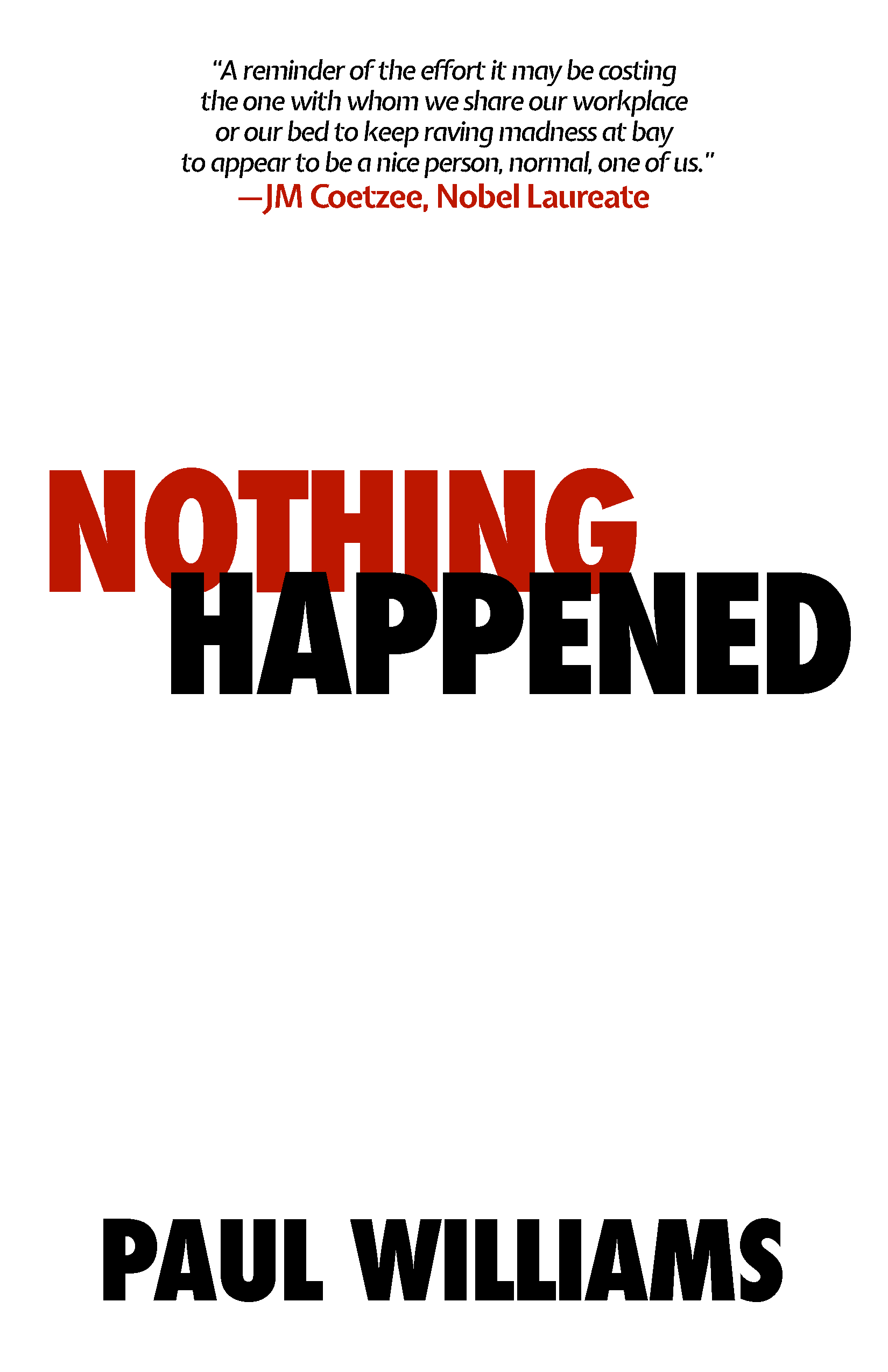
Williams is a psychologist, and a rather famous one. He’s renowned especially for a three-volume autobiography in which he describes the kind of childhood most can only imagine unless you’ve lived it yourself. And that’s the point of those books, and also of Nothing Happened. Unless you can understand what it’s really like to grow up abused and utterly neglected, you cannot really help someone who was. And it’s really not easy to understand it, but because Paul Williams lived it and wrote about it, it’s a lot easier for others to understand it.
Nothing Happened is a fucking brilliant book, not just because of the story it tells but because of the way it tells it. See, when you disassociate as a child like I did, you develop a really different way of thinking than most others do, and Williams expresses this perfectly in the book’s writing. You tend to draw the wrong conclusions about events, and you especially misread the intended meaning of what others say and do. People who attempt to show care or concern come across instead as would-be abusers, while people showing abusive traits feel familiar and thus “safe” (or at least honest).
And this is how it is for the protagonist of Nothing Happened, Tim. Tim imagines that everyone knows something he doesn’t, while what he knows (and is) is so horrible that he needs to protect them from himself.
He’s aided in this logic by a figure he calls the Tramp, a toxic, poisonous being spewing acid on everything good in order to “murder” it before it murders Tim.
At the risk of giving away too much of the book itself, the Tramp is a result of a fucked-up trauma bond between Tim and his own father, a voice constantly telling him that he’s wrong. Not wrong as in “incorrect,” but wrong as in “shouldn’t be allowed to live.” And because Tim regardless keeps living, the Tramp constantly tries to poison everything good that happens to him.
Tim, like me and like many other abused kids, also disassociated from his body. For me, my body was a heavy and burdensome annoyance I had to propel through the world, but it was never a person. For Tim, on the other hand, his body is a cadaver that he’s frozen in a block of ice in order to protect it from anyone else harming it. Keeping it frozen means never enjoying any physical sensation, especially but not only sex, because those things can awaken the cadaver and it’s too fragile to be out in the world.
I won’t tell you much more about the book, because it’s too brilliant for you not to read it yourself. But I’ll tell you one more thing about its power: it’s because of the book I finally confronted my own father.
Over the past few decades, I’d tried unsuccessfully to break off contact with him. What tripped me up each time was that aforementioned trauma bond, the belief that the man who abused me was, perversely, the only person whose approval ultimately mattered. So, even decades later, I’d answer his weird and barely-coherent guilt-wracked messages with assurances he was really a good person and no, he didn’t really mess me up and so he shouldn’t feel so guilty.
And then, I was editing a section of Nothing Happened, where Tim finally understands that the awful parents he tried to get affection from as a kid actually were the real problem.
That very same day, my father sent me yet another message in search of some kind of absolution. I surprised myself by my reply. “Actually, dad, beating me really fucked me up. And you’ve never apologized for this.”
What followed is what I’ve already told you. He denied he’d ever done it, and then changed his mind, “remembering” that he’d stopped using a belt on me when I was 2 (and then changing it to 3), and quite suddenly it was all my fault again, not his, and then I told him I’ll never speak to him again.
And I haven’t. And I won’t.
It was because of Paul Williams’ book and the support of friends I could finally get to this point, and the power of that act is still unfolding and compounding throughout my life. And while psychoanalytic concepts often get misused and contorted in their public dissemination, the process of soul murder (and resurrection) Paul Williams writes about in Nothing Happened is even more profound than the personal liberation I experienced working on the book.
I am very sorry that all of that happened to you. I think that your victory (in releasing the trauma-bond) helps establish a morphic field for others to do the same. Grateful for you.
Hey Rhyd, great sign that you can write about this now.
Hope the book helps others.