

Sundry Notes, May
Reviving Tradition, Jungian Coaching, Identity Politics Funding, and more

I. The Return of a Tradition
In several essays over the years, I’ve lamented the dying of ancient traditions here in Luxembourg. That there are any ancient traditions still here is a wonder, of course, but their persistence makes their fragility that much more painful.
One of those traditions is the Kiermes. Those are ancient week-long village festivals in which everyone related to anyone in that village, through blood or through marriage, returned to celebrate. Though likely predating Christianity, they became linked to either the founding day of the village church or to the feast day of the church’s patron saint (and often, for reasons that any magician would understand, the church was founded on the patron saint’s day).
There’s not been a Kiermes in the village where I live for many decades, but many of the older residents (including my mother-in-law) still remember them. The stories I’ve heard of them have been fascinating and beautiful, but always tinged with the sadness of nostalgia. Everyone would wear their best clothes and serve hams they’d cured specifically for the festival week. Imagine American Thanksgiving, but for 7 days instead of one, and instead of inviting just your extended family, you invited everyone connected in any way to the village. Sure, there was also a mass, and everyone was expected to be there for it, but if anything, that mass served as a chance to sober up a little and finally digest all the food you’d been eating before you started it all again.
Though modernity and capitalism came late to Luxembourg, it hit really hard here, demolishing traditions wherever it could. The Kiermes was a particular victim of its brutality, having sundered so many familial and community relationships so quickly that the yearly festivals became smaller and then, suddenly, no one would show up.
When I heard the stories from my mother-in-law and saw old photos of what these festivals once looked like, I became profoundly sad. Especially hard was the sense that something so beautiful, something that had been the highlight of every year, had just slipped away and no one could really understand why.
Today, though, there was a Kiermes here, the first in over thirty years. Thanks to my husband, who now works in cultural and integration planning for our region, the tradition was revived. Sure, it was a bit different from the last one. The older folks still got their traditional jambon-frites-salat meal, and a local family made sweet waffles, but there was also Syrian food provided by a local restaurant which exclusively hires refugees, and two of the residents of a local refugee hotel served Turkish coffee and sweets.
The mixing of the old and the new was brilliant, fluid, and fully unforced. I spent quite some time with the refugees; being an immigrant myself, I find it much more interesting to talk with them than with native Luxembourgers (and anyway, I much more prefer their cuisine).
Besides the ease in which all the groups got along, what was heartening was how easy my husband made it look to revive an ancient tradition. As soon as he put the idea out, our oldest neighbors (one in his 90’s) had quickly arranged for the waffle stand and a mass to be said in the village church, and the rest of the village got excited immediately. They had only needed someone younger to care enough to bring the festival back, and the rest basically fell into place.
Especially, seeing how the oldest folks in the village — especially my mother-in-law — practically glowed with youth and memories was the most heartening of all.
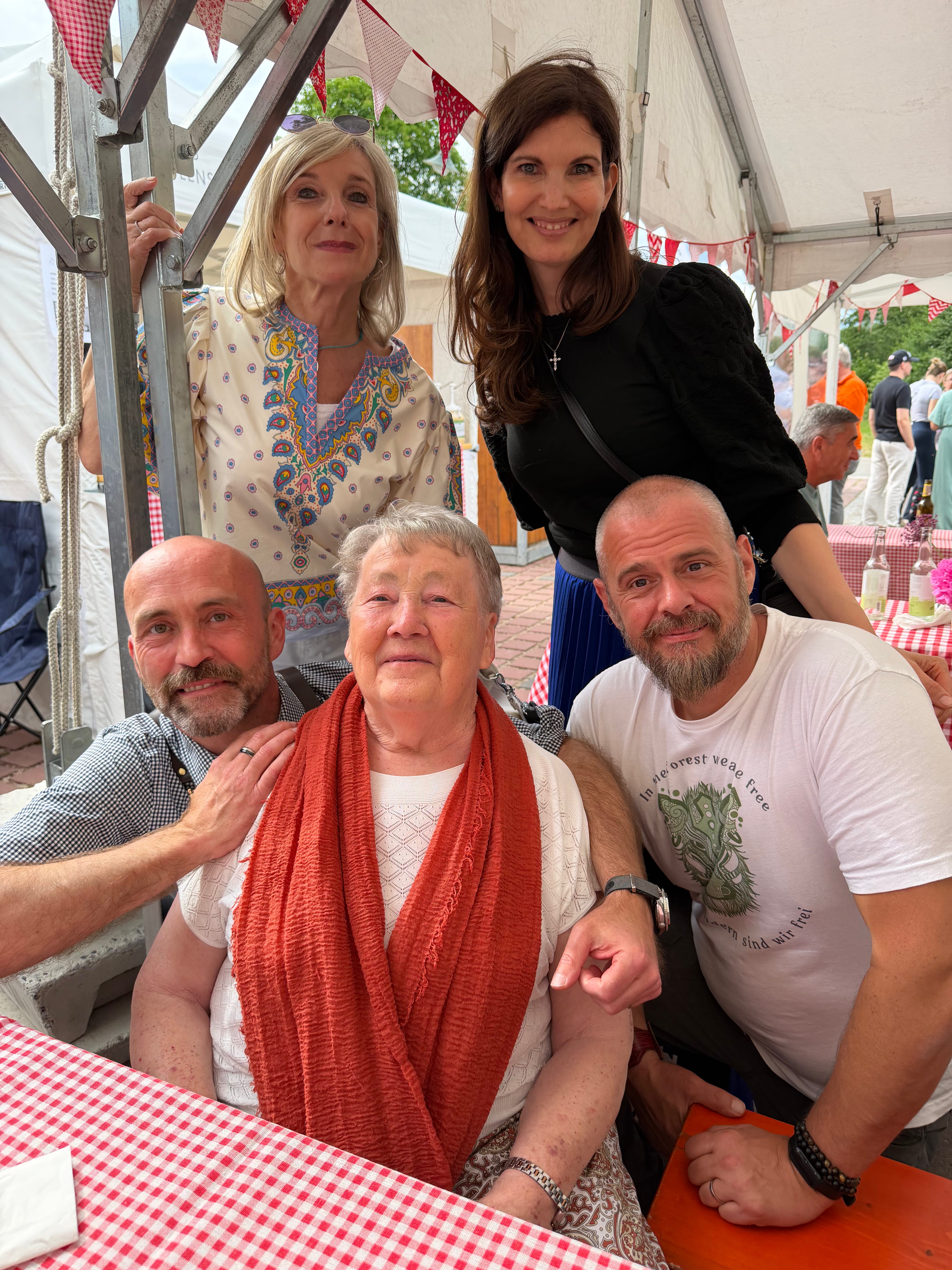
If you want to resist capitalism and modern alienation, while also giving people a sense that old ways still have meaning, this is absolutely a beautiful way to do it.
II. Update on Jungian Coaching
A few weeks ago, I started working with a small group of early Jungian coaching clients. I can’t begin to tell you how humbling, awe-inspiring, and beautiful I’ve found this work to be. My husband has to endure a lot of “Oh my gods, I love my work!” anytime he’s in the house just after one of the sessions has ended. (Fortunately, he also loves his own work, so we’re both gushing a bit at each other).
There’s one bit of wisdom I first heard years ago from one of those “new age” sorts that we usually ridicule (and sometimes for good reason). But it wasn’t some idea that arose in the psychedelic 70’s; rather, it was a much older one, one of those truths that many religions discovered.
In essence, it’s that when you’re on the right path for yourself, it will be obvious to you. Things fall into place and the way feels easy and smooth. The way I put it to my sister as she was trying to decide between two very large life-determining options: “If it’s your path, it will feel more like a broad highway instead of a crowded city full of narrow one-way alleys.”
The Tao Te Ching, of course, puts this much more poetically:
Tao is empty
yet it fills every vessel with endless supplyTao is hidden
yet it shines in every corner of the universeWith it, the sharp edges become smooth
the twisted knots loosen
the sun is softened by a cloud
the dust settles into place.
Becoming a Jungian coach has been exactly like this. It feels very much as if it was somehow inevitable that I’d do this, like it was already written and I just now got to that part of the book. In other times of my life where I’ve had this feeling, it’s as if time expanded and collapsed at the same time, like the future and the past were always now. It’s the same feeling as in friendship or in love, that sense you have always known someone you’re just meeting for the first time.
I’ve come to think of such times as alignments, in the same way that planets and standing stones are alignments. There are giants in the sky dancing, and giants on the earth pointing, and they’re all talking with each other and also with you. Taoism would say that these are moments when you are in the Tao, rather than just trying to know it. Christians might call it moments of “grace” or “providence.” Jung called these moments “synchronicity.” They’re all describing something that cannot really be put into words, only lived, but the words they use suffice enough to remind us it’s something always possible and always available to us.
And on the matter of coaching, I’ll be making space to take four more pay-as-you-will clients very soon. If you’d like to be one of them, the information for that is here.
III. Identity Politics Funding Is Drying Up
If you’re not hearing so much about identity politics lately, there’s a reason for that.
In my series, “How the Left Got Fucked,” you’ll know that I blame a significant part of the left’s shift away from anti-capitalism and towards social justice identitarianism on capitalism itself.
What happened was that, over the last few decades, large financing organizations invested heavily in non-profit and institutional groups that advocated an identity-first framework in their activism. The effects of all that funding, spread out over hundreds and thousands of small groups, was that identity-based struggles gained prominence while anti-capitalist critiques were choked out. This all happened in the same way that watering and fertilizing some plants means they’ll overgrow nearby plants that aren’t getting the extra attention.
For a good example, imagine a city facing a housing crisis. There aren’t enough available apartments, and so the rents are so high that many poorer people in the city cannot afford to live where they work. (You probably don’t need to imagine too hard, as this is the situation in every major city in the world.)
Now, let’s say you have two community activist groups in that city fighting to fix this problem, but each comes at it from a different framework. One group argues for rent control and stronger tenants rights, while the other group wants to obtain rent subsidies for black single mothers since they are disproportionately affected by the housing crisis.
In every situation like this, it would be the latter group, the one advocating an identity-based solution, that would get grants from larger “accelerator” funds and investment groups. That’s because this second option (identity-based activism) doesn’t actually require any real change in the capitalist system of housing, nor does it threaten landlords and property owners in any way. And for those funding organs, it looks really good to give money towards racial equity, but not so good if your money is going to anything that will prevent landlords and developers from profiting.
Now, imagine this same situation across hundreds of cities and hundreds of issues, and you’ll get a really good idea why the left hasn’t really talked about capitalism since Occupy. There was no money in anti-capitalism, but there was lots of money in social justice.
The operative word here is “was.” In the last few years, funding for social justice activism has been drying up internationally. Some of this was due to Trump’s decision to cut USAID, which was a major funding mechanism for social justice programs outside of the United States. Related to this were cuts by Trump to other national programs that had funded these groups under Biden and Obama.
But there’s a larger, non-Trump reason for this change. Here in Europe, the biggest hit to social justice activism was the 2023 decision by Open Societies Foundation to cut staff and financing, especially in Europe. Thousands of groups, including activist non-profits, “citizen journalist” organizations (always critical of Russia, never of NATO or the EU), and identity-first advocacy groups lost their budgets. That forced them to either downsize or shut down completely.
And that has significantly changed the narrative here in Europe. You hear people talking about capitalism again, even activists who had made a name for themselves talking initially about identity. It’s also changed the political parties on the left, who are finally trying to speak to the working class again (though it’s probably too late for most of them, since memories are much longer here).
For Americans, while there’s still plenty of money being pumped into such groups in the US, it’s a lot less than before. So, if you’re starting to notice that you just don’t hear some of the most extreme identity politics stuff that you were hearing a few years ago, that’s because the capitalists funding that kind of stuff aren’t doing so. And that means there’s more of a chance you’ll hear about anti-capitalism again.
IV. Sul Books Summer Sale
I thought you’d like to know that Sul Books, the publisher I run, is having a 25% off sale on everything for June and July. This includes all our books (including 8 of mine), T-Shirts, and courses.
Also, we have quite a few new books coming out, including an expanded edition of my book, Being Pagan.
Later this week, I’ll tell you more about that and also about some of the other books we’ve published recently and will be publishing soon. But in the meantime, here’s the link to our bookstore (and use code SUMMER26 for the 25% off discount).
I'm curious about what is going to replace identity politics. I may be pessimistic but I suspect much of the defunding of identity politics is because they have accomplished the goal they were funded for. A generation or more has grown up in a world where class-based politics is silenced. The left is in chaos internationally. The point of building a straw man is always to knock it down in the end and this seems to be what is happening with identity politics. I don't know if identity politics will be replaced with more class consciousness or if a new red herring will be invented to replace it. Possible options I see are some form of politicization of trauma culture. That one scares me because while there is excellent work being done to address the effects of trauma, I also see themes of evangelical purity culture and elitism in some aspects of trauma culture- for example, the idea that people who have experienced traumatic events are damaged and if they don't have the cash to pay a therapist to train them how to express themselves the way the elite does they can't have anything worth saying and the distrust in our communities based on fear of trauma. But that's only one possibility among many.
Congratulations on the success of the Kiermes revival - Mom and son look so proud 🌺